Skip to main content Skip to navigation

COVID-19 Research

Accordion Table
Title: Accordion Table
Sub Title: Accordion Table
  • Section description 

    A healthy immune system functions through innate and adaptive immunity, the ability to defend against antigens, discriminate between self and nonself, remember previous infections, and cease to attack once the pathogen is removed from the system. The various types of immune cells, their intricate architecture and elaborate regulation, enable the body to maintain homeostasis and activate an adaptive immune response as needed. With flow cytometry, you are able to precisely and rapidly analyze a large number of immune cells, enumerate and characterize them, identify specific surface and intracellular markers of immune subtypes, and assess depletion of immune cells after procedures.


  • Innate immunity is the primary and immediate cellular response of the body to pathogenic attack through the recognition of conserved features of the pathogens. The recognition of molecular patterns associated with microbes is mediated by pattern-recognition receptors (PRRs), which include both surface receptors (Toll-like receptors (TLRs) and c-type lectin receptors (CLRs)) or cytoplasmic receptors (TLRs, nucleotide-binding oligomerization domain (Nod)-leucine-rich repeat-containing receptors (NLRs), RIG-I-like receptors (RLRs). PRRs recognize two types of ligands—conserved structures of microbial pathogens, known as PAMPs (pathogen associated molecular patterns), and danger signals from altered-self, known as DAMPs (danger associated molecular patterns). Activation of PRRs by their ligands gives rise to the mobilization of innate immune cells and the secretion of signaling and effector molecules (cytokines and antimicrobial peptides) leading to an inflammatory response to neutralize the pathogen or the danger.1 This first line of response is often a prerequisite to trigger initial responses from the adaptive immunity.

  • A hallmark of macrophages is their phagocytic capabilities supporting the clearance of intruders and priming immune responses. However, macrophages also enable other essential homeostatic functions such as metabolism.3 Macrophages are highly involved in tumor development and progression as tumor associated macrophages (TAMs) secrete factors inducing immune tolerance towards tumor cells. They are therefore of great interest in immuno-oncology and are central to investigations evaluating the impact of therapy on the tumor microenvironment (TME). Two main types of macrophages are described based on their stimuli induced polarization—M1 and M2. M1 macrophages are pro-inflammatory, promote an oxidative state with reactive oxygen species (ROS) production, and secrete inflammatory cytokines and chemokines, e.g., IL-1, IL-6, IL-12, TNF-α, CXCL9, CXCL10. M2 macrophages are considered immunosuppressive and secrete anti-inflammatory factors such as IL-10 and TGF-β.4

  • testtesttest
    testtesttest
    testtesttest
    testtesttest
    testtest

    test

    Granulocytes are cells rich in cytoplasmic granules and include basophils5, neutrophils6,7, eosinophils8 and mast cells.9 Granulocytic cells support an array of protective functions including phagocytosis (neutrophils) defense against parasites (basophils) and as effectors in allergy (mast cells) and modulate host responses during immunotherapy.


Enlarged Coronavirus cells on a dark backdrop.
RY586
Down Arrow Up Arrow

Introducing
BD Horizon RealYellow™ 586 (RY586) Reagents

BD Horizon RealYellow™ 586 (RY586) Reagents are now available as the first in the rapidly growing family of innovative, laser-specific fluorochromes. They are excited primarily by the 561-nm yellow-green laser and offer:


  • Minimal cross-laser excitation off the 488-nm blue laser
  • Bright fluorescence to detect low-expression surface and intracellular markers 


Conventional flow cytometry: Just as bright as PE, but with significantly less cross-laser excitation, RY586 reagents can be used instead of PE on conventional flow cytometers for more flexible panel design.


Spectral flow cytometry: With a distinct spectral profile from PE, RY586 reagents can be used with PE on spectral flow cytometers to increase parameters for deep scientific insights.

 
performance1

Excellent Resolution

Generate reliable data that clearly resolve even the most challenging cell populations by leveraging bright, clean fluorochromes that minimize spillover and background.

Flexible Panel Design

Maximize panel design options for both conventional and spectral flow cytometry by using reagents that deliver minimal cross-laser excitation in hundreds of antibody specificities.

High-Dimensional Analysis

Reveal more insights from the same sample by expanding the utility of blue and yellow-green laser channels with reagents that enable the simultaneous use of more detectors.

Performance

Click through the slides below to view performance data.

RB780
Down Arrow Up Arrow

BD Horizon RealBlue™ 780 (RB780) Reagents—the superior alternative to PE-Cy7

RB780 reagents leverage an innovative laser-specific fluorochrome, excited primarily by the 488 nm blue laser to offer.


  • Minimal cross-laser excitation off the 561-nm yellow-green laser
  • Bright fluorochrome to support the detection of low-expression surface and intracellular markers 
  • Reduced monocyte background compared to PE-Cy7


Download the BD Horizon RealBlue™ 780 Reagents Brochure >

 
performance1

RB780 reagents can be used instead of PE-Cy7 on conventional flow cytometers or with PE-Cy7 on spectral flow cytometers


RB780 reagents can be used with PE-Cy7 on appropriately configured conventional and spectral cytometers with both a 488-nm blue and 561-nm yellow-green laser to increase the number of experimental parameters.

Performance

BD Horizon™ RB780 Reagents offer minimal cross-laser excitation off the yellow-green laser and reduced background compared to PE-Cy7

RB-780 Emission Profile

Normalized emission profile of PE-Cy7 and RB780 with RB780 minimal excitation off the 561-nm yellow-green laser.

Human whole blood was stained with BD Horizon™  RB780 Human CD4 (SK3) Reagent, acquired and compensated on a BD FACSymphony  A5 SE Cell Analyzer.

BD Horizon™ RB780 Reagents offer reduced background compared to PE-Cy7

Applications

BD Horizon RealBlue™ 780 Reagents are compatible with a broad range of fixation and permeabilization systems


BuffersResults
BD FACS™ Lysing Solution and BD Pharm Lyse™ Lysing BufferCompatible
CellBlox™ Blocking BufferCompatible
BD Cytofix™ Fixation BufferStable at least 24 hours
1% PFAStable at least 24 hours
BD Cytofix/Cytoperm™ Fixation and permeabilization SolutionCompatible with antibody staining before and after fixation
BD FACS™ Permeabilizing Solution IICompatible with antibody staining before and after fixation
BD Phosflow™ Perm III BufferCompatible with antibody staining before and after fixation
EDTA and HeparinCompatible
BD Horizon™ Brilliant Stain Buffer (BSB)Compatible


item 1
item 2item 3item 4
12312345123456789
101112YesNo101112
testing131415161718131415
item 1,3item 2,5item 3, 5item 4, 5
1224
RB545
Down Arrow Up Arrow

BD Horizon RealBlue™ 545 (RB545) Reagents

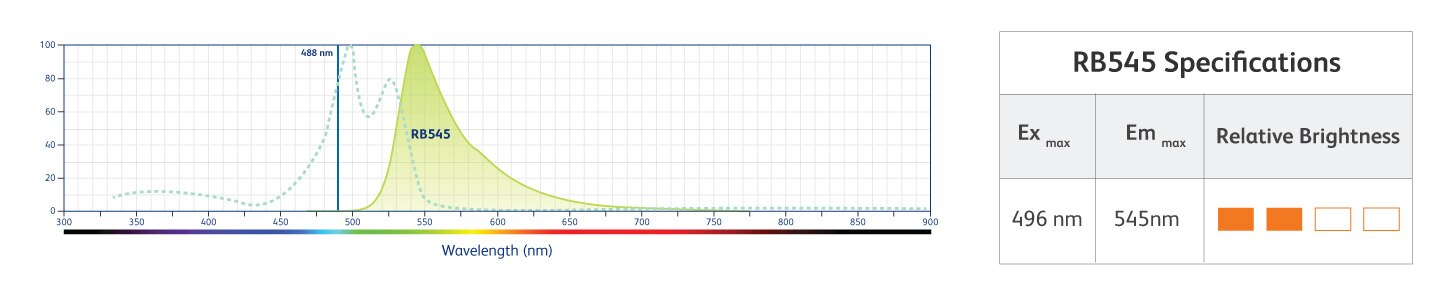
RB545 reagents are innovative laser-specific fluorochromes excited primarily by the 488-nm blue laser that offer:


  • Minimal cross-laser excitation off the 561-nm yellow-green laser
  • Moderate brightness fluorochrome to support the detection of high-expression surface and intracellular markers


Download the BD Horizon RealBlue™ 545 Brochure>

 
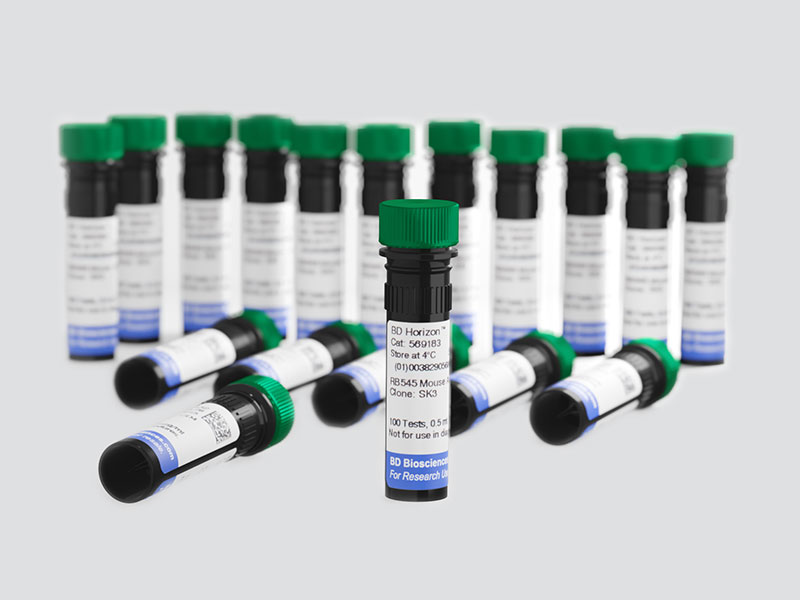
RB545 vials
performance1

RB545 reagents can be used on spectral cytometers to increase the number of experimental parameters.

Performance

BD Horizon™ RB545 Reagents offer minimal cross-laser excitation off the yellow-green laser

RB545 Normalized Emission Filter Parameters
apps1
RB545 Spread Plots
apps1

Applications

BD Horizon RealBlue™ 545 Reagents are compatible with a broad range of fixation and permeabilization systems


BuffersResults
BD FACS™ Lysing Solution and BD Pharm Lyse™ Lysing BufferCompatible
CellBlox™ Blocking BufferCompatible
BD Cytofix™ Fixation BufferStable at least 24 hours
1% PFAStable at least 24 hours
BD Cytofix/Cytoperm™ Fixation and Permeabilization SolutionCompatible with antibody staining before and after fixation
BD FACS™ Permeabilizing Solution IICompatible with antibody staining before and after fixation
BD Phosflow™ Perm III BufferCompatible with antibody staining before and after fixation
EDTA and HeparinCompatible
BD Horizon™ Brilliant Stain Buffer (BSB)Compatible