Alert : The site is undergoing maintenance. Some functionality including sign-in may be impacted
Saturday, February 21, 3:00 pm through Tuesday, March 03, 9:00 pm (PST), 2026
Ordering can continue through fax and phone.
Contact usFlow cytometry has been widely used for decades as a highly sensitive tool for immunophenotypic analysis and is playing an increasing role in biomarker detection in clinical trials, e.g. in the expanding clinical trials landscape in oncohaematology, including CAR-T clinical trials.1 Next Generation Flow™ (NGF) for MRD (Minimal Residual Disease) represents one of the latest advancements in this powerful technology, enhancing precision, efficiency, and standardisation to deliver peerless reproducible results. Clinical research investigating immune mechanisms frequently uses immune assessment to understand the processes of immunotherapeutic approaches.
BD offers integrated solutions from sample preparation to data analysis to provide accurate, consistent results in your clinical development program. The need for standardised, certified techniques that can demonstrate compliance with regulations is essential to achieve consistency and efficiency, reduce error and inter-operator variability, and enable reproducibility over multiple centres.
Next Generation Flow™ (NGF) makes it possible to rapidly acquire several millions of cells and therefore reach the sensitivity of molecular methods. Standardization at every step of the process, coupled with innovative software tools, yields accurate, reproducible and objective results.2
The rapid and precise performance of NGF can therefore offer advantages in a clinical trial setting for MRD evaluation:
*BCP-ALL: B-cell precursor acute lymphoblastic leukaemia
Standardisation of all process steps is of added value in clinical trials to reduce inter-operator variability during processing and analysis of samples and to reduce error prone steps, thereby enabling reproducibility of results in an efficient manner across multi-centre studies.
Automation allows you to reduce hands-on time, decrease operator variability, and reduce time for documentation due to automated processes enabling sample and reagent traceability.
Clinical trials are run in a regulated environment where different compliance related topics can be relevant, like Fit-for-purpose validation, support of 21 CFR part 11 features and IVDR depending on the nature of the trial.
NGF as a technique for BCP-ALL and Multiple Myeloma MRD evaluation offers multiple benefits in a clinical trial setting:
Acute lymphoblastic leukaemia (ALL) is the first neoplasm in which the evaluation of the initial response to treatment through the assessment of MRD has proven to be a fundamental tool to manage therapeutic decisions.7 High quality MRD assessment data demonstrating the efficacy of new and emerging treatments (such as targeted therapy e.g., bi-specific AB, CAR-T therapy) is needed if these treatments are to be made available and more patients are to benefit.
New drugs and techniques have assisted the improvement in progression-free survival over the past ten years for those suffering from multiple myeloma (MM); however, a number of patients who respond well to treatment still relapse due to MRD.9 The NGF methodology developed by EuroFlow™ for the detection of MRD in MM is endorsed by the International Myeloma Working Group, which included it as a technique of choice in their last review of the response assessment criteria.10
CPC antibody panel combination can be used to study plasma cells in peripheral blood in flow cytometry.
BD Infinicyt™ software is designed for multiparametric analysis of complex flow cytometry data with patented tools and adaptable to common laboratory workflows:
A large global install base of BD’s IVDR-compliant BD FACSLyric™ Flow Cytometer allows easy collaboration across industry, clinical trial sites, and academic labs, supporting FDA 21 Code of Federal Regulations (CFR) Part 11 features and enabling electronic portability of user-defined assays.
Features that facilitate your setup of clinical trials:
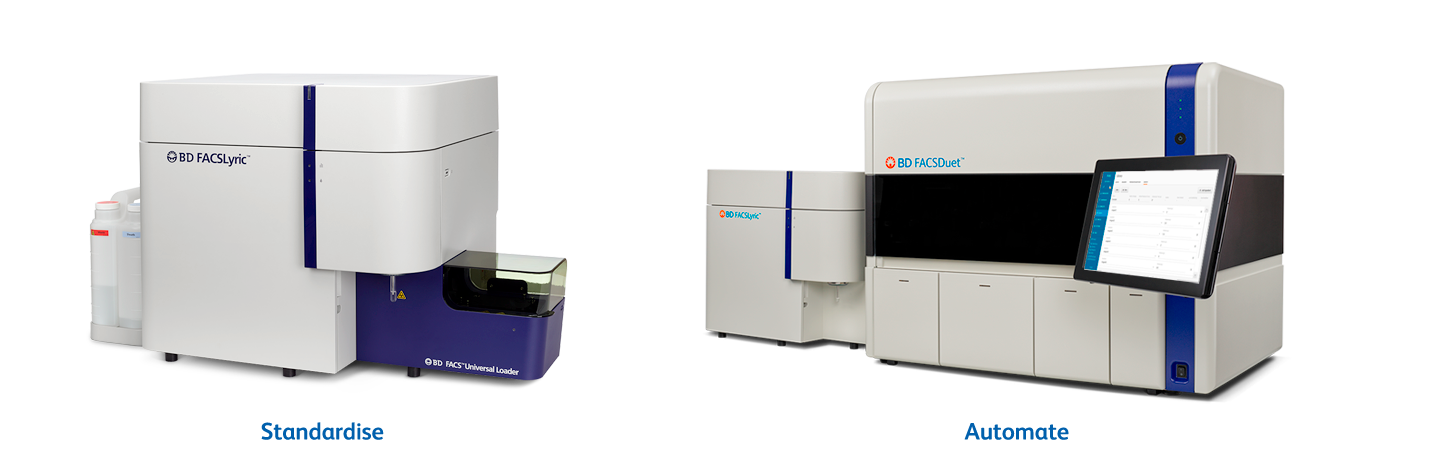
The BD FACSDuet™ Sample Preparation System is a comprehensive system that provides a complete walkaway workflow solution offering automatic sample transfer through physical integration with the BD FACSLyric™ Flow Cytometer. This helps drive standardisation, consistency, and data reproducibility for both IVD and user-defined assays. The BD FACSDuet™ Premium System further enhances efficiency with optional on-board washing and centrifugation, accommodating a variety of assays, reducing hands-on time, and helping maximise resources for both Lyse-No-Wash and Lyse-Wash-assays. The system offers flexibility for different sizes and tubes of specimens. For Lyse-No-Wash assays 96-well plates are enabled.
Reagent cocktailing functionality allows on-board automated antibody cocktail preparation, eliminating the risk of errors in manual pipetting and driving automated recording of all used antibodies for easier tracking and auditing. With the use of vial adaptors, the system enables compatibility with a wide variety of reagent vials from a range of manufacturers. The system delivers complete traceability, with easy-to-pull reports of specimens, worklists, and reagents, facilitating inventory and data management. Features related to 21 CFR Part 11 are supported with an audit trail.
The Clinical and Laboratory Standards Institute (CLSI) recently published guideline H62, which focuses on the unique ‘fit-for-purpose’ requirements for the analytic validation of cell-based assays performed by flow cytometry in a clinical trial setting.12 The recommended validation strategy depends on the intended use of the flow cytometry data and its associated level of clinical risk. In a clinical trial, where the intended use of the data is for end points not related to patient care or treatment, the assay would be considered low clinical risk. Clinical trial biomarker assays used to determine enrolment into a clinical trial and therapeutic intervention may be considered high clinical risk.12
The European In Vitro Diagnostic Medical Device Regulation (IVDR) (EU) 2017/746 came into effect on 26 May 2017 and replaces the European In Vitro Diagnostic Medical Device Directive (IVDD) 98/79/EC.13EU IVDR Amending Regulations (EU) 2022/112 and (EU) 2023/607 expand the scope of the grace period to certain devices and the abolishment of the sell-off provisions of IVDR. We received our first IVDR product certification back in December 2020 and the majority of BD’s previous IVDD compliant devices are now IVDR compliant. We are continuing our efforts to achieve this for current and new products in our clinical portfolio.
The Medical Device Coordination Group (MDCG) 2022-10 document outlines that an assay in the context of a clinical trial might fulfil the definition of an IVD medical device according to IVD Regulation 2017/746 Article 2.14
This states that, when a medical decision is involved, e.g., for inclusion and exclusion of subjects, treatment allocation, or monitoring the safety of the treatment during the trial, it is the responsibility of the clinical trial sponsor to determine the regulatory status of the assay based on the planned use in the trial.13
Companion Diagnostic (CDx) is in scope of IVDR, CDx devices will have to meet all applicable requirements as laid down in the IVDR. Built on a foundation of excellence and immunological expertise, BD Biosciences is committed to unlocking the potential of flow cytometry–based CDx solutions.
BD is an excellent partner for CDx development based on acknowledged diagnostic expertise:
NGF as a technique for BCP-ALL and Multiple Myeloma MRD evaluation offers multiple benefits in a clinical trial setting:
Acute lymphoblastic leukaemia (ALL) is the first neoplasm in which the evaluation of the initial response to treatment through the assessment of MRD has proven to be a fundamental tool to manage therapeutic decisions.7 High quality MRD assessment data demonstrating the efficacy of new and emerging treatments (such as targeted therapy e.g., bi-specific AB, CAR-T therapy) is needed if these treatments are to be made available and more patients are to benefit.
New drugs and techniques have assisted the improvement in progression-free survival over the past ten years for those suffering from multiple myeloma (MM); however, a number of patients who respond well to treatment still relapse due to MRD.9 The NGF methodology developed by EuroFlow™ for the detection of MRD in MM is endorsed by the International Myeloma Working Group, which included it as a technique of choice in their last review of the response assessment criteria.10
CPC antibody panel combination can be used to study plasma cells in peripheral blood in flow cytometry.
BD Infinicyt™ software is designed for multiparametric analysis of complex flow cytometry data with patented tools and adaptable to common laboratory workflows:
A large global install base of BD’s IVDR-compliant BD FACSLyric™ Flow Cytometer allows easy collaboration across industry, clinical trial sites, and academic labs, supporting FDA 21 Code of Federal Regulations (CFR) Part 11 features and enabling electronic portability of user-defined assays.
Features that facilitate your setup of clinical trials:
The BD FACSDuet™ Sample Preparation System is a comprehensive system that provides a complete walkaway workflow solution offering automatic sample transfer through physical integration with the BD FACSLyric™ Flow Cytometer. This helps drive standardisation, consistency, and data reproducibility for both IVD and user-defined assays. The BD FACSDuet™ Premium System further enhances efficiency with optional on-board washing and centrifugation, accommodating a variety of assays, reducing hands-on time, and helping maximise resources for both Lyse-No-Wash and Lyse-Wash-assays. The system offers flexibility for different sizes and tubes of specimens. For Lyse-No-Wash assays 96-well plates are enabled.
Reagent cocktailing functionality allows on-board automated antibody cocktail preparation, eliminating the risk of errors in manual pipetting and driving automated recording of all used antibodies for easier tracking and auditing. With the use of vial adaptors, the system enables compatibility with a wide variety of reagent vials from a range of manufacturers. The system delivers complete traceability, with easy-to-pull reports of specimens, worklists, and reagents, facilitating inventory and data management. Features related to 21 CFR Part 11 are supported with an audit trail.
The Clinical and Laboratory Standards Institute (CLSI) recently published guideline H62, which focuses on the unique ‘fit-for-purpose’ requirements for the analytic validation of cell-based assays performed by flow cytometry in a clinical trial setting.12 The recommended validation strategy depends on the intended use of the flow cytometry data and its associated level of clinical risk. In a clinical trial, where the intended use of the data is for end points not related to patient care or treatment, the assay would be considered low clinical risk. Clinical trial biomarker assays used to determine enrolment into a clinical trial and therapeutic intervention may be considered high clinical risk.12
The European In Vitro Diagnostic Medical Device Regulation (IVDR) (EU) 2017/746 came into effect on 26 May 2017 and replaces the European In Vitro Diagnostic Medical Device Directive (IVDD) 98/79/EC.13EU IVDR Amending Regulations (EU) 2022/112 and (EU) 2023/607 expand the scope of the grace period to certain devices and the abolishment of the sell-off provisions of IVDR. We received our first IVDR product certification back in December 2020 and the majority of BD’s previous IVDD compliant devices are now IVDR compliant. We are continuing our efforts to achieve this for current and new products in our clinical portfolio.
The Medical Device Coordination Group (MDCG) 2022-10 document outlines that an assay in the context of a clinical trial might fulfil the definition of an IVD medical device according to IVD Regulation 2017/746 Article 2.14
This states that, when a medical decision is involved, e.g., for inclusion and exclusion of subjects, treatment allocation, or monitoring the safety of the treatment during the trial, it is the responsibility of the clinical trial sponsor to determine the regulatory status of the assay based on the planned use in the trial.13
Companion Diagnostic (CDx) is in scope of IVDR, CDx devices will have to meet all applicable requirements as laid down in the IVDR. Built on a foundation of excellence and immunological expertise, BD Biosciences is committed to unlocking the potential of flow cytometry–based CDx solutions.
BD is an excellent partner for CDx development based on acknowledged diagnostic expertise:
BD Flow Cytometers, BD FACSDuet™ Sample Preparation System and BD FACSDuet™ Premium Sample Preparation System are Class 1 Laser Products.
BD FACSDuet™ Sample Preparation System, BD FACSDuet™ Premium Sample Preparation System, BD FACSLyric™ Flow Cytometer with the BD FACSuite™ Clinical and BD FACSuite™ Application, Bulklysis™, BCP-ALL MRD Panel, MM MRD Panel, PIDOT Panel and BD Infinicyt™ analysis software are in vitro diagnostic medical devices bearing a CE mark.
BD Multitest™ Reagents (excluding 333184, 333185) and BD Trucount™ Tubes are in vitro diagnostic medical devices bearing a CE mark and are CE certified by BSI Group The Netherlands B.V. (Notified Body Number = 2797).
CYT-CPC and Custom dried multicolour panels are for Research Use Only. Not for use in diagnostic or therapeutic procedures
The EuroFlow trademark is the property of the EuroFlow Consortium and cannot be reproduced or published without prior written permission from the EuroFlow coordinator (www.euroflow.org).
BD, the BD Logo, FACSDuet, FACSLyric, FACSuite, Infinicyt and Next Generation Flow are trademarks of Becton, Dickinson and Company or its affiliates.
Bulklysis is a trademark of Cytognos. Cytognos S.L. is a 100% subsidiary of BD.
© 2024 BD. All rights reserved. BD-110178 (v1.0) 0124